
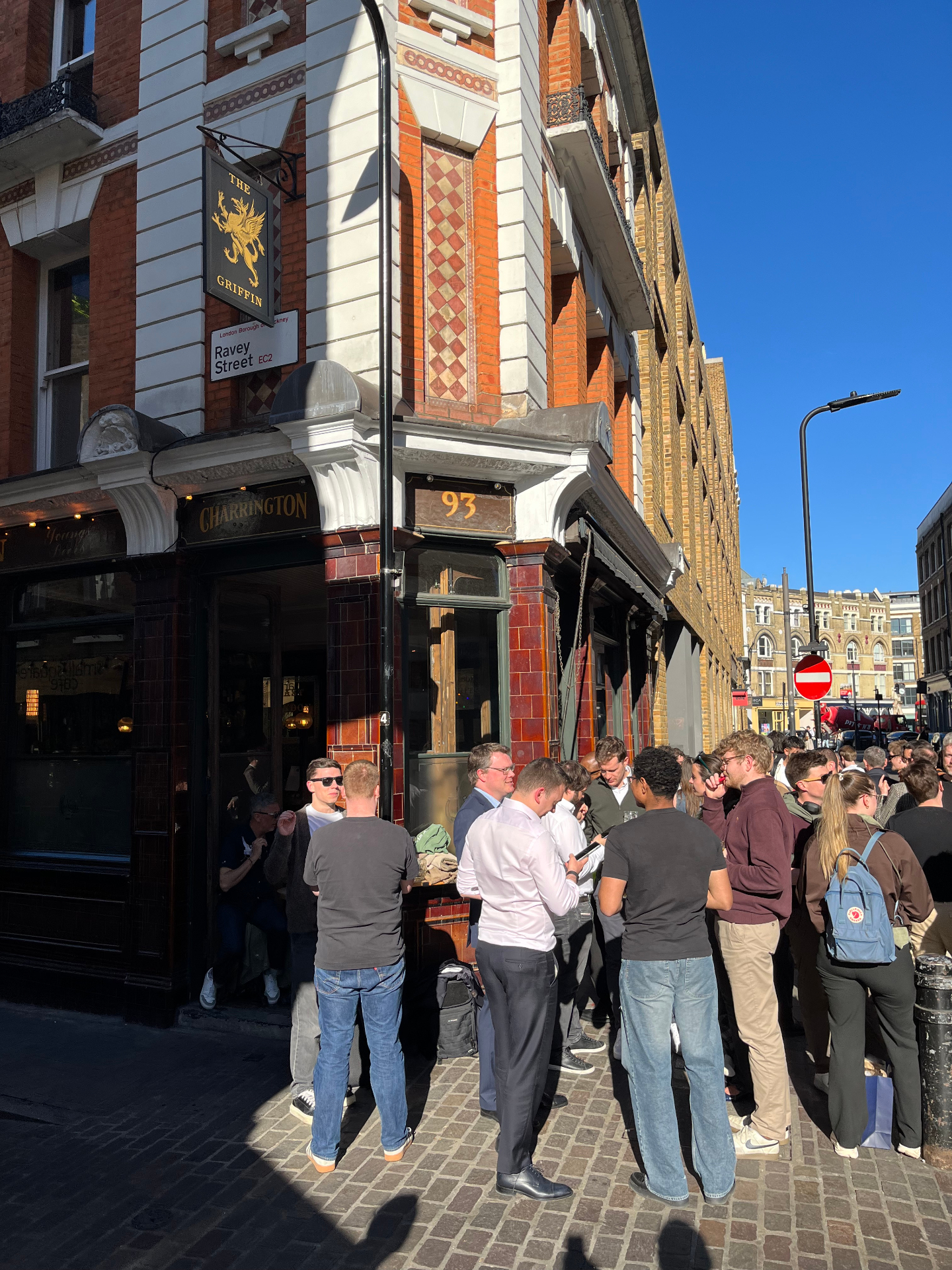
The Original Third Place
Sociologist Ray Oldenburg named pubs "the heart of a community's social vitality and the foundation of a functioning democracy" — spaces for voluntary, informal gatherings beyond home and work. London's public houses have filled that role since Roman tabernae in 43 AD, eventually numbering one for every 200 people in Elizabethan England. Unlike the world outside, the pub levelled hierarchies — eventually welcoming anyone and everyone under the same roof.
Pubmaxxing is our shorthand for that tradition: showing up, sitting down, and letting a room of curious strangers turn into something more.
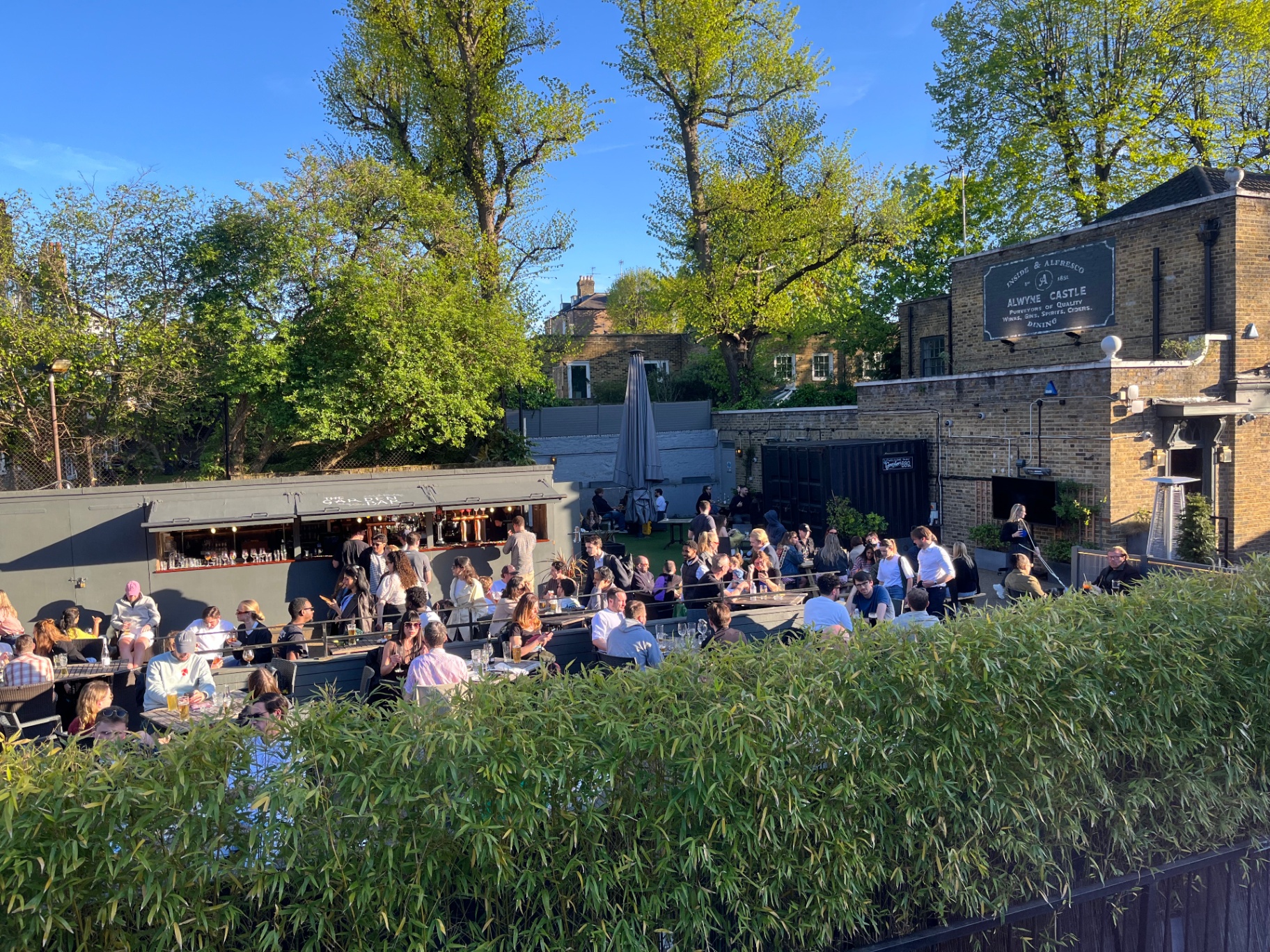
The coffeehouse spark
The Royal Society — the world's oldest national scientific academy, whose Fellows include Newton, Darwin, Einstein, and Alan Turing — grew from informal gatherings of natural philosophers in London taverns and coffee houses during the 1640s. On 28th November 1660, following a lecture at Gresham College in the City of London, twelve men agreed to form "a College for the Promoting of Physico-Mathematicall Experimentall Learning" — and the scientific method as we know it was formalised
Fleet Street and the literary pubs
Ye Olde Cheshire Cheese on Fleet Street, rebuilt after the Great Fire in 1667, drew Samuel Johnson, Charles Dickens, Mark Twain and W. B. Yeats. Johnson compiled his Dictionary a few doors down; Dickens wove the surrounding alleys into A Tale of Two Cities.
Around the corner, journalists from every national paper drank at the Punch Tavern and El Vino, filing copy by day and arguing politics by night. Fleet Street's pubs were, for two centuries, the unofficial newsroom of the country.
Soho, science and the Bloomsbury set
At The Eagle on Bene't Street's London cousin — and more famously the Soho pubs around Dean Street — writers, painters and exiles refined ideas that reshaped the century. The Fitzroy Tavern hosted Dylan Thomas, George Orwell and Augustus John; the French House sheltered the Free French during the war and Francis Bacon after it.
A short walk away, at The Eagle in Cambridge, Crick and Watson announced they'd 'found the secret of life.' London's pubs played the same role for countless smaller revolutions: a neutral table, a pint, and someone willing to listen.
The Pub Gave Space to Those Who Had None
London's pubs and bars have been places of genuine belonging for communities who found few other welcoming spaces — the Gateways Club in Chelsea ran for over fifty years as the world's longest-surviving lesbian club, drawing women from across Britain, while the Royal Vauxhall Tavern has hosted LGBTQ+ Londoners continuously since the Second World War, becoming England's first building listed specifically for its LGBTQ+ significance. Sylvia Pankhurst's East London Federation of Suffragettes converted a derelict pub into the Mothers' Arms — a creche, clinic, and community hub that delivered practical rights and dignity to working-class women in 1915. These were not just places to drink — they were the rooms where people found their communities, built their confidence, and organised the movements that changed Britain.
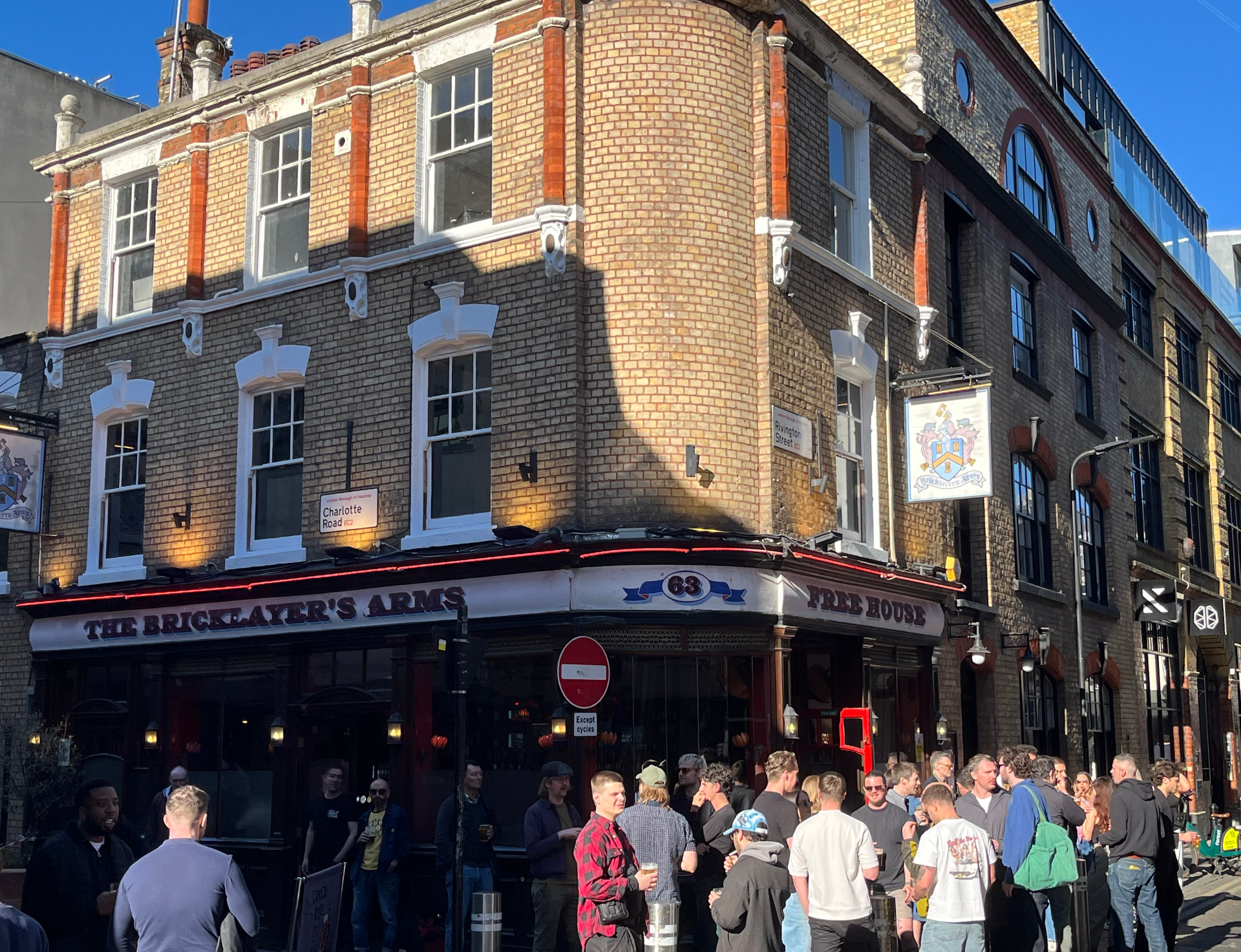
Music and the Arts
The Half Moon in Putney has hosted Kate Bush's first public show, U2's first UK sell-out gig, and early performances by Ed Sheeran, Van Morrison, and Elvis Costello since 1963. David Bowie established his folk club — the Beckenham Arts Lab — at the Three Tuns pub in South London in 1969, performing there 37 times as he crafted the identity that would make him iconic. Amy Winehouse was a regular at the Hawley Arms in Camden before and during the making of Back to Black — the pub's jukebox directly inspired the sound of the album, and it was the creative and social hub where she met collaborators, soaked up influences, and found the emotional raw material that became one of the best-selling albums of the 21st century.
The format hasn't changed much in 350 years. A room, a few good people, and the conversation that follows. Pubmaxxing is the simple bet that London's next great ideas will start the same way they always have: meeting someone new, exchanging an idea, and being part of the next big movement in the world's greatest city.
How to make the most of an evening pubmaxxing
Leave a gap in your circle.
A closed circle is a closed conversation. Stand in a horseshoe, not a full ring — it signals "this is an open conversation, join us." It's the single easiest thing you can do to make the whole room feel more alive.
Make one move every 20 minutes.
Don't anchor to the first person you meet. Set a loose internal timer — finish your drink, then shift. The best conversation of the night is almost always the one you nearly didn't have.
Ditch "What do you do?" — try these instead:
- "What's something you've changed your mind about recently?"
- "What's the best thing you've discovered this year — could be a place, a person, a podcast, anything?"
- "What are you in the middle of figuring out right now?"
These questions give people something generous to answer — a story, an opinion, a recommendation — rather than a job title. You'll learn something interesting, and so will anyone nearby listening in.
Find someone standing alone and go to them.
They're not antisocial — they're waiting for someone like you. Research consistently shows people underestimate how much others want to be approached. The person on the edge of the garden is often the most interesting one there.
Before you move on, swap WhatsApp — not LinkedIn.
Frame it as a genuine exchange: "If I come across something I think you'd love — a place, an opportunity, a person — I'll send it your way." That framing turns a contact into the start of an actual relationship, and makes following up feel natural rather than transactional.
Look out for each other on the way out.
Before you leave, do a quick scan — is anyone heading home alone late at night? Offer to walk someone to the tube, share an Uber, or simply wait with them at the stop. That small gesture can really leave a good impression on the whole evening, ensuring everyone gets home okay.