
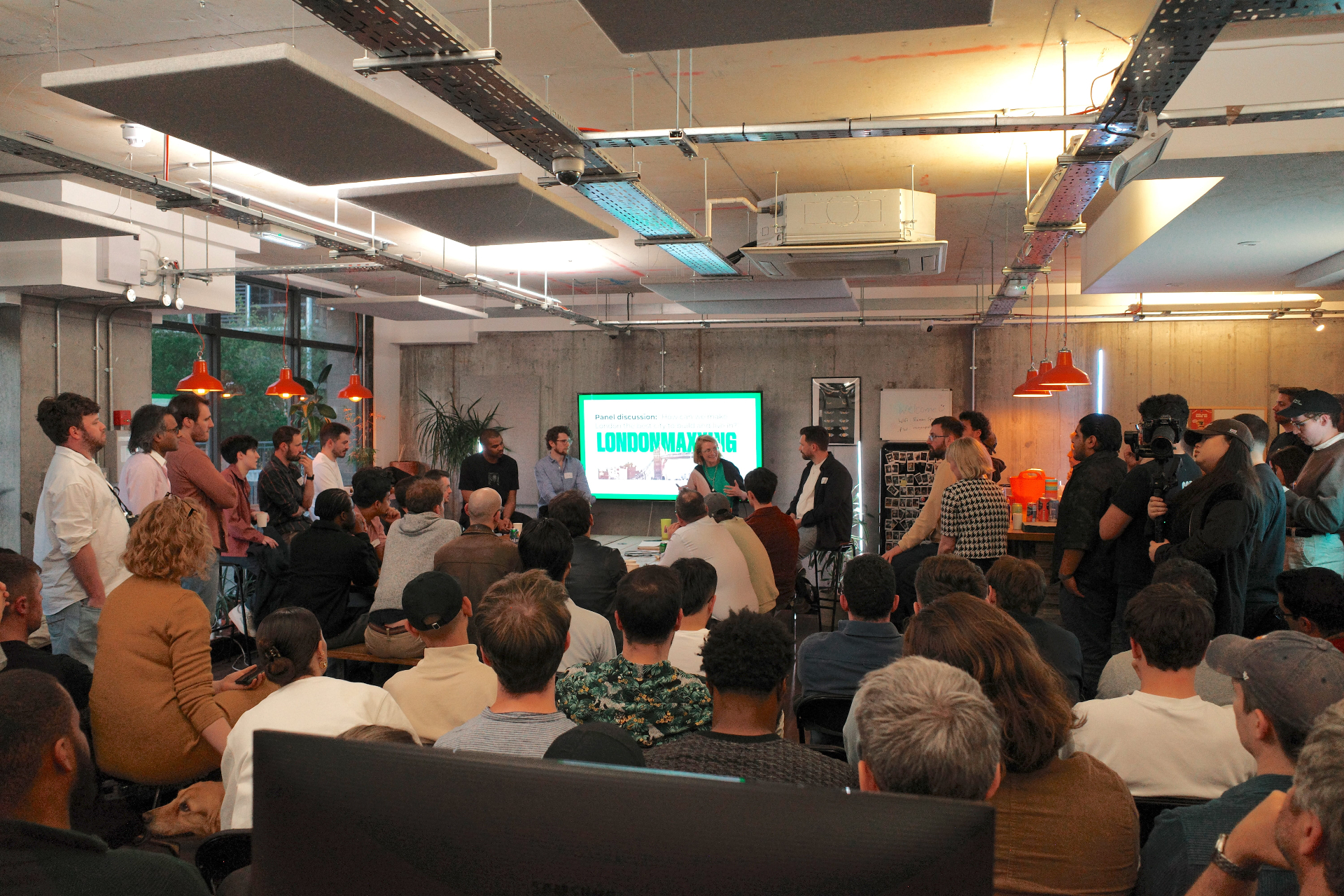
We're still recovering from all the buzz from last week.
From the opening to the panel sessions, and all the way to the end when the room was banging, chanting, and cheering for London, the energy was real.
As the first sold-out Londonmaxxing event at Ramen Space, it felt like a real marker moment. One made for the history books.
Here is a recap of the best bits:
Gritcult opened with a quick, punchy presentation on how London mogs SF. A successor to his classic "Bull Case for London" article. He laid out the updated case with numbers to back it up. Arguing that the city's cost basis, global positioning, deep talent network, and cross-sector diversity give it a clear, structural edge over the Valley.
Then, with the help of Charlie Ward, our host and moderator, we asked the panelists: "How can we make London the best city to build and live in?"
- Joe Reeve: Forest City, Looking for Growth, Future House, Eleven Labs
- Sarah Drinkwater: GP at Common Magic, formerly Google Campus
- Joshua Tulloch: Co-founder, PLUGGED
1. Why does London feel alive again?
Sarah: London has it all in a way no other city does. SF has tech. New York has media and finance. DC has politics. London has all of them at once, and super-diversity was a term coined for this place. The last couple of years sucked for events, but the fix is simple: if you want to do something, do it. Patriotism in the UK is treated as cringe, and that's part of what we have to push against. "There's a lot of cool stuff we have done and continue to do. It's pendulum swings."
2. What makes this moment different compared to previous ones?
Sarah: A few things are happening at once. Attention is on San Francisco, even as America looks increasingly unstable while its tech scene stays strong. Europe is getting more serious about sovereignty, and the UK is stuck in the middle.
Sarah: London tech is now so big it risks fragmenting under its own success. When I joined my first startup in a Shepherd's Bush basement, I did not know anyone else in startups. Now the problem is the opposite. There is so much happening that shared culture is harder to maintain.
Sarah: The fix is physical. Rituals, rooms, the lunch that happens at the same time every day. "Those are the collisions."
3. What is the big opportunity for London?
Joshua: Capital. America's structural advantage was always the size of its capital pools but founders don't need capital like they used to, especially in software. Each pound of European capital now does more work than it did five years ago.
Joshua: Companies are coming out of London and Stockholm. US capital is rotating toward more durable returns. London is "perfectly placed as the bridge" between two centres. The job is to compound speed: ship in days not weeks, hire in days not weeks, raise in days not weeks.
Sarah: London has always been pluralistic, and that's the unfair advantage. Capital is now a commodity, which means investors have to work harder which is a net good. "Power is shifting."
Joe: This isn't just a London boom, it's a global one. AI is causing a creative and economic surge everywhere. Paris is alive. Tokyo is alive. The opportunity is for any city to catch this wave. London is well-placed to ride it, but if our cohort fumbles, the city might not get a strong shot at the next one. "It's not just that everything's getting better. There's an opportunity, and if we don't grab it, we lose out."
Sarah: San Francisco isn't really a city but it works because it behaves like a collective wealth project. It is small, networked, and full of people with a shared incentive to make the place richer and more powerful.
Sarah: We are less supportive of that kind of shared project in the UK. We are often too quick to say this is not good enough yet, and that attitude weakens the ecosystem. Wealth is not just a private good. It is what funds the roads, hospitals, schools, and jobs people say they want. It deserves to be treated more like a shared endeavour, and right now we have the opportunity to see growth as a good thing again.
4. What does growth politics actually require?
Joe: Looking for Growth has taught us that policy work is both bottom up and top down. You need outreach to people in rooms like this, and you need people pushing ideas into the circles around politicians.
Joe: We may never get an explicitly Looking for Growth government, just as we have never really had an explicitly Green government. But we can still get lots of pro growth outcomes passed by governments of different stripes.
Joe: A lot of the time, most politicians just need good ideas brought to them. They do not need every voter convinced first; they need a handful of people around them to believe the idea is popular, credible, and worth backing. One Forest City board member meets Rachel Reeves every fortnight, and her opening question each time is the same: how do I get economic growth? They are trying. They just need the brief.
Joe: That is why showing up matters. Posting matters. Filling in the form matters. Being counted matters. The small things that feel slightly cringe are often the things that make the next conversation possible.
Sarah: The first UK tech boom in the late 90s coincided with New Labour: pro-business, pro-social-safety-net, growth as a positive word. A whole class of first-wave entrepreneurs heard that message and ran with it. Macron's France today is hardcore cheerleading. That's the lever: vibe management. The Sovereign AI Fund is "actually pretty fucking cool". A year ago I was sceptical about it but now I am optimistic.
5. What's making it harder than it should be to build and live here?
Joshua: We are wasting talent on a huge scale. People who should be curing cancer are making slides for McKinsey.
Joshua: The problem is not just personal choice. It is cultural routing. Careers fairs, student societies, and prestige pipelines all push top students toward consulting and law, while startups barely register as a visible option.
Joshua: I went to Oxford expecting to find people trying to change the world, but the dominant mindset was how to get onto the next grad scheme. I left without really knowing what startups were, and only ended up in them because I could not pass the consulting tests.
Joshua: That is the real issue: there is no legible, de-risked entrepreneurial path that plays the role grad schemes play for students. Roughly 7,000 accelerator and incubator places exist in the UK each year, while 67 percent of Gen Z say they want to start a business.
Joshua: Without that infrastructure, the founder path is simply too risky for a lot of high-potential people. If you are a student who could build something important, there is no obvious mechanism to de-risk the leap, no entrepreneurial equivalent of the grad scheme, and no clear system to catch you if you want to try.
Joshua: "There is no infrastructure to catch them."
Sarah: Partly yes, but not entirely. Friction is often the point; many of the best founders I've worked with never came through neat, approved routes. Accelerators aren't a silver bullet. The deeper issue is cultural: we've been conditioned to act as if a conventional employer will reward our loyalty. But look at the evidence, big tech and consulting firms are laying people off in droves. The illusion of safety has already been shattered. If your job isn't going to love you back, you have to stop waiting for permission. The truth is, you can just do things.
Joe: I am somewhere in the middle between the two of you. Great founders might not need permission, but most people need some social proof, legitimacy, and cover. Accelerators help by "deprogramming" people from the McKinsey-fication of their careers and making the path legible enough that even their parents stop panicking, getting them off their back long enough to actually build something.
6. Forest City is a genuinely big idea. Can we influence cultures to think bigger?
Joe: The frame here is the Overton Window. Some ideas sound crazy until somebody says them out loud, and then the next slightly less crazy version starts to look reasonable.
Joe: That was part of the logic behind announcing Forest City on stage at the O2, even with only a small chance of success. If someone later says let's build a tram, the idea lands differently once a city has already been proposed.
Joe: "I gave Forest City a 5% chance of succeeding. It seemed worth announcing because then, in two years, when somebody comes out with something less ambitious, people will say, well, it's not that crazy. The other guy said he's going to build a city. Let's build a tram."
Joe: In practice, that already seems to be happening. Other infrastructure campaigns have started reaching out to ask how to do the same thing.
Sarah: Big ideas work partly because people like helping with cool things. Enthusiasm is magnetic so if you're enthusiastic about something cool, other people will think it's cool too. The dancing-on-the-hill metaphor matters. When I decided to start a fund without a VC background, people responded to the ambition, and now women in places all over the world write to say they want to do the same.
Sarah: My personal motto is "Don't be a hater. Only hang out with lovers."
Joshua: PLUGGED started from a simple frustration. Post COVID London tech events were bad, so the obvious move was to throw something better. A house party for 40 founders in Peckham turned into a room full of people sitting on cushions listening to the former head of UK Ops at Airbnb until 4am, and each time the format got bolder, people responded well.
Joshua: The deeper reason is that founders already live in an ideas economy. Big and bold is the native language of the scene. The next generation has not yet fully absorbed the old pessimism, and that is a real advantage.
7. What did Google Campus get right?
Sarah: Google Campus worked because it mixed ambition, generosity, density, the willingness to share what worked and fun. London startups sucked at the time, Google had money to spend so they bought a six-storey building in Old Street and gave founders a place to work for free with no equity taken.
Sarah: A lot of what made it work was deliberate. Every floor had a coffee table. The lift was always breaking, so people met on the stairs. The design nudged people into collision after collision.
Sarah: Some of it was scale. There were 700 events a year. Seedcamp was there. Entrepreneur First started there. Revolut spent its first year in the building when almost nobody knew who they were, and there was already a Bitcoin ATM in the cafe in 2014.
Sarah: Demis Hassabis came through for a fireside chat the year after the DeepMind acquisition. The building made startup ambition feel visible, normal, and social.
Sarah: "The secret ingredient is always fun. You're hanging out with your friends. Some of them make some amazing companies."
Sarah: London does not need one exact replica of Campus. It needs ten next generation versions of it, built for the city as it exists now.
8. What's one thing everyone can do tomorrow to improve the London scene?
Joshua: Open your network. There are only five co working spaces in London serving early stage founders: PLUGGED, Ramen Space, Encode, Super Team, and Unicorn Mafia.
Joshua: "That's criminal."
Joshua: If you have access to a venue, a speaker, capital, or empty commercial property, route it toward a community builder. That is where a lot of leverage lives.
Joshua: David from Shoreditch Exchange is a good example. David gave PLUGGED a floor on a revenue share deal after WeWork left the building half empty. PLUGGED ran events, activated the space, and within a year the building was at 85% occupancy, with EF, Jack and Jill and others moving in.
Joshua: "David has done more for London tech than the vast majority of people in this city." Hug your local co-working space provider because it's a difficult job they are doing.
Joe: Figure out what the people running the things you care about are actually trying to achieve, then help them. Showing up to the events matters more than people realise. The photos and videos make the next event easier to fund and fill. Fill in the cringey forms. "Ten thousand people who agree with me" is what unlocks the next conversation with a minister, an investor, or a landlord. The form-filling feels silly. It is not silly.
Sarah: Be the guy cringily dancing on the hill so other people start dancing too. Tell a friend tomorrow you were here. Give freely.
9. Which company would you most want to relocate to London?
From the audience
Joe: The US government. Not allowed? Fine. Anthropic. They are already on the fence.
Sarah: Prime Intellect. The vibes are culturally English even though they're SF-based.
Joshua: Stripe and I'm leaning on the fact that London is a financial centre and we could use a company like that to pull ambitious talent out of safer, slower institutions.
10. Is the London slander on social media organic or adversarial?
From the audience
Sarah: It is probably a mix. Some of it is algorithmic, some of it is incentive driven, and some of it is just dumb Americans in Austin trying to score cheap points off a city they do not know. As a long-time Londoner who's lived on four continents and always come back: walking around Walthamstow in real life is beautiful. "There's more of us than them."
Joe: London isn't perfect. My garage was broken into three days ago. There's graffiti everywhere but that is not a reason to write the city off. I think "It's a fucking awesome city. And it's worth trying to fix the things that are wrong with it." On most metrics it's much better than twenty years ago.
Joshua: A more interesting counter narrative is already emerging through media. More shows are being set in London, filmed in London, and using the city as an actual character rather than just a backdrop.
Joshua: New York figured this out a long time ago. London is starting to catch up, and each new show set here makes the slander look thinner and less convincing.
Quotes worth keeping
"Most of our politicians…A lot of the time they just need positive ideas brought to them."
"The UK is one of the only cultures in the world where being patriotic is cringe."
"Be the guy cringily dancing on the hill to make people dance with you."
"There is a criminal misallocation of talent in this country. People who should be curing cancer are making slides for McKinsey."
"SF is basically a collective wealth project. It's small, it's networked, and they have a really strong shared incentive to pick it up."
"There are five co-working spaces for the whole of early-stage London. That's criminal. That's the bottom layer of the ecosystem and if it doesn't work, the whole thing fractures."
"I gave Forest City a 5% chance of succeeding. It seemed worth announcing because then, in two years, when somebody comes out with something less ambitious, people will say well, it's not that crazy. The other guy said he's going to build a city. Let's build a tram."
What's next
We're cooking.
Next up is our content series, May meetup, and June event.
If you have an idea, a venue, a connection, or want to volunteer, go to londonmaxxing.com/contact.
If you took something away from last week, post it with #londonmaxxing. The point Joe, Joshua and Sarah all made is the right one to end on: filling in the feedback forms, sharing the message via posts, and showing up to the events is how the thing gets bigger.
We'll see you at the next one. Let the Londonmaxxing continue.